17 Beautiful Luang Prabang Temples You Shouldn’t Miss (2026 Guide)
The temples of Luang Prabang are one of the main reasons why I fell in love with this beautiful UNESCO World Heritage city in Laos. There is something magical about wandering through its quiet streets and unexpectedly finding a golden Buddhist temple hidden around a corner or watching the afternoon light illuminate centuries-old mosaics and gilded roofs. Unlike many places in Southeast Asia that feel rushed and overcrowded, Luang Prabang invites you to slow down.
I have visited Luang Prabang twice and spent almost twenty days exploring the city. During my travels, I visited temples on both sides of the Mekong River, climbed Mount Phousi to discover its sacred shrines and breathtaking views, and crossed the river to explore peaceful monasteries that many visitors never make it to. Every temple featured in this guide is one that I personally visited.
With more than thirty Buddhist temples scattered throughout the city, choosing which Luang Prabang temples to visit can feel overwhelming, especially if you only have a few days. Some are among the most important Buddhist temples in Laos, while others are hidden gems where I found myself completely alone, listening to birds singing and the occasional sound of temple bells in the distance.
What I loved most about exploring the temples of Luang Prabang is that no two feel exactly the same. Some are magnificent and richly decorated with gold leaf and colourful mosaics, while others are wonderfully simple and peaceful. Some offer spectacular views over the Mekong River, while others tell fascinating stories connected to Lao royalty and centuries of Buddhist traditions that continue to shape daily life in the city today.

These temples are not museums or tourist attractions created for visitors. They are living places of worship where monks study, pray and carry out their daily routines. Early in the morning, novice monks sweep the temple grounds while local people arrive quietly to make their offerings. Visiting the Buddhist temples of Luang Prabang offers much more than beautiful photographs—it is also an opportunity to experience the spiritual heart of Laos.
This guide brings together sixteen beautiful Luang Prabang temples that I explored during my two visits to the city. You’ll find some of the city’s most famous monasteries, including Wat Xieng Thong and Haw Pha Bang, as well as lesser-known temples across the Mekong River and hidden gems that deserve far more attention than they receive. I’ll also share practical information to help you plan your visit, including temple etiquette, opening hours, entrance fees and suggested itineraries.
My biggest piece of advice? Don’t try to see everything as quickly as possible. One of my favourite memories of Luang Prabang isn’t of a particular temple but of simply sitting quietly in a temple courtyard and appreciating the peace that makes this city so special. Slow down, take your time and allow yourself to experience Luang Prabang at its own gentle pace. I have a feeling you’ll fall in love with it too.
Why Visit the Temples of Luang Prabang?
If you asked me what I enjoyed most about Luang Prabang, visiting its temples would probably be at the top of my list. I never got temple fatigue here, something that has happened to me in other destinations in Southeast Asia. On the contrary, I was always looking forward to discovering the next temple.
What I loved most was that they are all so different. Some are among the most famous temples in Laos and receive hundreds of visitors every day, while others are quiet and almost empty. Some can be visited in just fifteen minutes, while others deserve an hour or two of your time.
Exploring the temples also takes you to different parts of Luang Prabang. You’ll wander through the historic centre, climb Mount Phousi, enjoy beautiful views over the city and even cross the Mekong River to discover ancient monasteries that many travellers never visit.
I was also surprised by how easy it is to visit many of the temples on foot. Luang Prabang is a small city and some of its most beautiful temples are only a few minutes apart, making it possible to spend an entire day temple hopping at your own pace.

Whether you decide to visit just two or three temples or spend several days exploring them, I don’t think you’ll regret making them a priority during your trip. They are one of the things that make Luang Prabang so special and, for me, one of the main reasons I would happily return to this beautiful city again and again.
Temple Etiquette in Luang Prabang
One of the things I loved most about Luang Prabang was how peaceful its temples are. You’ll see monks going about their daily lives, local people stopping to pray and make offerings and travellers quietly admiring the beautiful architecture. A little respect goes a long way and you’ll have no problem visiting the temples if you keep a few simple things in mind.
You need to cover your shoulders and knees when entering the Buddhist temples in Luand Prabang. The weather in Laos can be hot and humid, so I found lightweight clothing much more comfortable when spending several hours exploring the temples.
Before entering temple buildings, you’ll usually be asked to remove your shoes. If you’re planning on visiting a number of temples in one day, comfortable shoes or sandals that are easy to take off will make your life much easier.

Photography is generally allowed and you’ll probably find yourself taking far more pictures than you expected! Just be mindful of what’s happening around you. If people are praying or monks are chanting, I would simply wait or take photographs from a distance without disturbing anyone.
Finally, remember that these temples are not museums. They are sacred places that continue to play an important role in the daily lives of the people of Luang Prabang. Taking a few moments to appreciate where you are is perhaps the nicest way to experience them.
Luang Prabang Temples Map and Quick Comparison Table
| Temple | Entrance Fee | Recommended Visit | Best For |
|---|---|---|---|
| Wat Xieng Thong | 30,000 LAK | 1–1.5 hrs | Luang Prabang’s most famous temple, Tree of Life mosaic |
| Wat Sensoukharam | Free | 20–30 min | Red façade and peaceful atmosphere |
| Wat Syrimoungkoun Xaiyaram | Free | 15–20 min | White façade, gold-and-black stencilled pillars, and singha guardian statues |
| Wat Phonxay | Free | 20–30 min | Quiet neighbourhood temple |
| Wat Long Khoun | ~20,000 LAK (boat fare not included) | 30–45 min | Royal history and Mekong views |
| Wat Xieng Mene | Free | 20–30 min | Traditional village monastery |
| Wat Pa Phon Phao | Free | 45–60 min | Golden octagonal hall and viewpoints |
| Wat Aphay | Free | 20–30 min | Local temple in the historic centre |
| Wat Chomphet | ~20,000 LAK (boat fare not included) | 45–60 min | Best panoramic views across the Mekong |
| Wat Pa Had Siew | Free | 20–30 min | Historic Chomphet temple |
| Wat Tham Sakkarin | Free | 20–30 min | Quiet monastery off the tourist trail |
| Wat Chom Si | Included with Mount Phousi ticket | 30–45 min | Summit temple and sunset views |
| Wat Tham Phousi | Included with Mount Phousi ticket | 10–15 min | Sacred cave shrine |
| Haw Pha Bang | Included with Royal Palace Museum ticket | 20–30 min | Sacred Pha Bang pavilion |
| Wat Pa Houak | Free | 20–30 min | Historic murals |
| Wat Phan Luang Ratsoudaram | Free | 20–30 min | Peaceful local temple |

Wat Xieng Thong
Wat Xieng Thong is undoubtedly one of the most beautiful and important temples in Luang Prabang and, if you only have time to visit one, this would be my recommendation. Built between 1559 and 1560 during the reign of King Setthathirath, it is considered one of the finest examples of traditional Lao Buddhist architecture. Located at the tip of the Luang Prabang peninsula near the confluence of the Mekong and Nam Khan rivers, the temple is famous for its sweeping roofs, intricate mosaics and magnificent Tree of Life artwork adorning the rear wall of the ordination hall.

I spent much longer here than I had originally planned simply wandering around the temple complex and admiring its beautiful details. One of the things that surprised me most was how much there is to see beyond the main temple building. Don’t miss the Royal Funerary Carriage House and take your time exploring the smaller structures scattered throughout the complex. Wat Xieng Thong is open daily from 8:00 AM to 5:00 PM and the entrance fee is 30,000 KIP. I would allow at least one hour for your visit, although photography enthusiasts could easily spend much longer here.


| Opening Hours | 8:00 AM – 5:00 PM |
| Suggested Visit | 1–1.5 hours |
| Entrance Fee | 30,000 LAK |
| Address | Khem Khong Road, Luang Prabang, Laos |
Wat Syrimoungkoun Xaiyaram
Wat Syrimoungkoun Xaiyaram is a peaceful Buddhist monastery located in the historic center of Luang Prabang. Although it is less visited than some of the city’s famous wats, it stands out for its elegant white façade, ornate gold-and-black stencilled columns, and white singha guardian statues at the entrance. If you enjoy exploring quieter corners of the UNESCO-listed old town, it is worth stopping by while walking between the better-known monasteries.

Opening Times: Approximately 8:00 AM – 5:00 PM
Suggested Duration: 15–20 minutes
Cost: Free (donations appreciated)
Location: Historic center of Luang Prabang, Laos
Wat Sensoukharam
I nearly missed Wat Sensoukharam. Like most people, I was walking towards Wat Xieng Thong and almost kept going. Then I looked across the street and saw this beautiful red temple with golden details, so I decided to have a look.
I’m really glad I did.
It wasn’t one of the temples I’d read loads about before my trip, but that’s exactly why I liked it. There weren’t many people around, nobody was rushing and I could just wander around for a while. I found myself stopping every few minutes to look at another carving or decoration. Sometimes I think the temples you remember most aren’t necessarily the biggest or the most famous.
Wat Sensoukharam dates back to 1718 and its name means “Temple of the 100,000 Treasures.” Today it’s still an active Buddhist temple, and when I visited it had a lovely, peaceful atmosphere. It felt like one of those places where you naturally slow down without even thinking about it.
If you’re already visiting Wat Xieng Thong, don’t make the same mistake I almost did and walk straight past it. It’s literally a couple of minutes away, entry is free, and even if you only spend twenty minutes here, I think it’s time well spent.
| Opening Hours | 8:00 AM – 5:00 PM |
| Suggested Visit | 20–30 minutes |
| Entrance Fee | Free |
| Address | Sakkaline Road, Luang Prabang, Laos |
Wat Phonxay
I found Wat Phonxay while doing what I enjoyed most in Luang Prabang—walking around without much of a plan. That’s how I explored the city during both of my trips. I’d pick a direction and see what I came across.
I almost didn’t go in because, from the outside, it looked like just another temple. I’m glad I did. It was quiet, there were hardly any other visitors and it gave me an excuse to escape the heat for a little while. I remember sitting there for a few minutes thinking how different Luang Prabang felt from so many other places I’d visited in Southeast Asia. Nobody was trying to sell me anything and there was no rush to move on.
Wat Phonxay isn’t the kind of place people travel across the world to see, and that’s probably why I liked it. It felt like a normal neighbourhood temple where life simply carried on. During my time in Luang Prabang, I realised that I often enjoyed these smaller temples just as much as the famous ones. They gave me a chance to slow down, look around and enjoy the moment instead of thinking about what I was going to visit next.
If you have a couple of days in Luang Prabang, I’d leave some time for places like Wat Phonxay. You don’t need a long checklist or a strict itinerary. Sometimes it’s enough just to wander in and see what you find.
| Opening Hours | 8:00 AM – 5:00 PM |
| Suggested Visit | 20–30 minutes |
| Entrance Fee | Free |
| Address | Luang Prabang Old Town, Laos |
Wat Long Khoun
One of the best decisions I made in Luang Prabang was crossing the Mekong. Most people spend all their time exploring the old town, but I was curious about what was on the other side of the river. It only took a few minutes by boat, but it felt like I had left the busy streets behind.
Wat Long Khoun was one of the reasons I made the crossing. The temple dates back to the 18th century and was once used by Lao kings before their coronation, but to be honest, what stayed with me wasn’t the history. It was how peaceful it felt. There were hardly any other visitors, so I could wander around without feeling rushed. I remember stopping every now and then to look across the Mekong towards Luang Prabang. It was a completely different view of the city and one that not everyone gets to see.
I spent longer there than I expected. That happened to me quite a few times in Luang Prabang. I’d tell myself I’d have a quick look, and then an hour would go by. If you’re already planning to visit Wat Chomphet, I’d definitely include Wat Long Khoun as well. For me, the boat ride, the quiet surroundings and the views across the river made it one of the most memorable temples I visited.
| Opening Hours | 8:00 AM – 5:00 PM |
| Suggested Visit | 30–45 minutes |
| Entrance Fee | Free |
| Address | Ban Xieng Mene, Chomphet District, Luang Prabang, Laos |
Wat Xieng Mene
By the time I reached Wat Xieng Mene, I wasn’t really thinking about temples anymore. I was just enjoying walking around on the other side of the Mekong. It felt so much quieter than the old town, and I remember thinking that crossing the river had been one of the best decisions of the day.
I stopped at Wat Xieng Mene because it looked inviting. There weren’t crowds of people coming and going, just a peaceful temple in the middle of the village. I walked around for a bit, took a few photos and then sat down for a while. There wasn’t anything I had to tick off or rush to see. It was just nice to be there.
I spent almost three weeks in Luang Prabang over two trips, and one of the things I loved most was slowing down. Back home I’m always looking at the time and thinking about what’s next. In Luang Prabang, I found myself doing the opposite. I’d often end up spending much longer somewhere than I’d planned because I simply didn’t feel like leaving.
Wat Xieng Mene is probably not the temple people travel to Luang Prabang to see, but I think that’s exactly why I remember it. It wasn’t about seeing another famous landmark. It was about enjoying a quiet afternoon exploring a place that felt completely different from the busy streets on the other side of the river.
| Opening Hours | 8:00 AM – 5:00 PM |
| Suggested Visit | 20–30 minutes |
| Entrance Fee | Free |
| Address | Ban Xieng Mene, Chomphet District, Luang Prabang, Laos |
Wat Pa Phon Phao
I visited Wat Pa Phon Phao during my second trip to Luang Prabang because I wanted to see more than just the temples in the old town. It’s a little further away, but I didn’t mind the walk. After spending a few days exploring the historic centre, it was nice to discover a different side of the city.
The temple is best known for its golden octagonal hall, which looks quite different from the other temples I visited in Luang Prabang. It also has beautiful views over the town and the surrounding countryside, so I spent some time walking around before sitting down to enjoy the view.
One of the things I remember most happened just before I entered the temple. A Buddhist monk was sweeping the entrance, so I stopped to talk to him. We ended up having a conversation about meditation. I told him I thought Buddhist monks spent hours meditating every day, so I was genuinely surprised when he told me he usually meditated for only about 30 minutes. He smiled and said that 30 minutes is enough if you meditate with full awareness. It’s a conversation I’ve remembered ever since because it wasn’t the answer I was expecting.
I visited Luang Prabang twice and spent around three weeks there altogether, but this is one of the memories that has stayed with me the most. It reminded me that travelling isn’t only about seeing beautiful places. Sometimes it’s a simple conversation that you end up remembering years later.
| Opening Hours | 8:00 AM – 5:00 PM |
| Suggested Visit | 45–60 minutes |
| Entrance Fee | Free |
| Address | Phou Vao Road, Luang Prabang, Laos |
Wat Aphay
I came across Wat Aphay while exploring the streets of Luang Prabang on foot. One of the things I enjoyed most about the city was that you never had to walk very far before finding another temple. Some were full of visitors, while others, like Wat Aphay, felt much quieter.
Wat Aphay, also known as Wat Aphayaram, was built in the 19th century and is still an active Buddhist temple. It may not be one of the best-known temples in Luang Prabang, but I think it’s worth stopping if you’re already walking around the historic centre. I liked the fact that it felt like a normal neighbourhood temple rather than a place that people rushed to tick off their sightseeing list.
I don’t remember every detail of my visit, but I do remember enjoying the slower pace of life around the temple. During my two trips to Luang Prabang, I realised that some of my favourite moments weren’t at the city’s biggest attractions. They were the times when I wandered into places like this without really planning to.
If you’re visiting Luang Prabang for a few days, I’d recommend leaving some room in your itinerary to explore without a plan. That’s how I found several of my favourite temples, including Wat Aphay, and I think it’s one of the best ways to experience the city.
| Opening Hours | 8:00 AM – 5:00 PM |
| Suggested Visit | 20–30 minutes |
| Entrance Fee | Free |
| Address | Luang Prabang Old Town, Laos |
Wat Chomphet
Climbing up to Wat Chomphet was one of the highlights of my time in Luang Prabang. After crossing the Mekong, I followed the path uphill, and although there are quite a few steps, I thought it was well worth the effort.

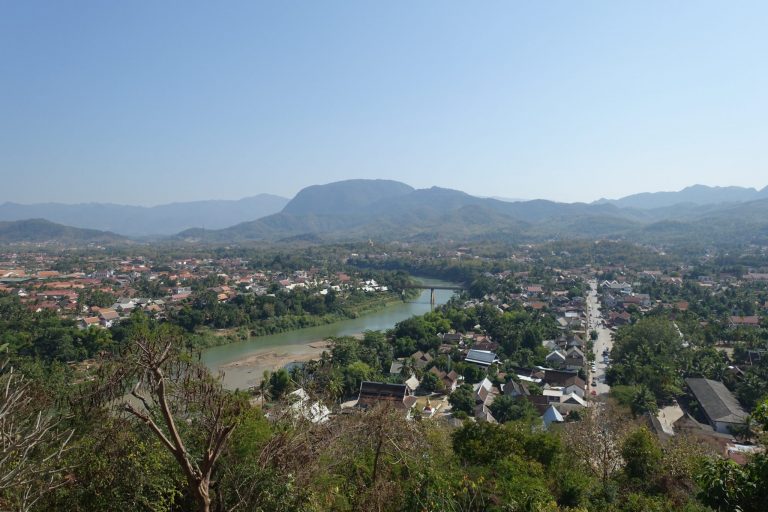
Wat Chomphet has been overlooking Luang Prabang for centuries, and the view from the top is one of the best I found during my two trips to the city. From here, you can see the old town, the Mekong River and the surrounding mountains. I stayed there much longer than I expected because I couldn’t stop looking at the view. It was also much quieter than climbing Mount Phousi, which made the experience even better.
I don’t remember many other people being there when I visited, and that made the place feel even more special. After spending time in the busy streets of Luang Prabang, it was nice to sit down for a while and enjoy the silence. Looking across the river towards the old town also gave me a completely different perspective of the city.


If you’re already visiting Wat Long Khoun and Wat Xieng Mene, I’d definitely continue up to Wat Chomphet. Most visitors never make it across the Mekong, but I think they’re missing one of the most rewarding places in Luang Prabang. The walk, the peaceful surroundings and the incredible views made it one of the temples I’ll always remember.
| Opening Hours | 8:00 AM – 5:00 PM |
| Suggested Visit | 45–60 minutes |
| Entrance Fee | Free |
| Address | Ban Chomphet, Chomphet District, Luang Prabang, Laos |
Wat Pa Hard Siew
Hidden among the trees on the Chomphet side of the Mekong, Wat Pa Had Siew is one of the oldest temples in the area. Although much smaller than some of Luang Prabang’s better-known temples, it has an important place in the history of the former royal capital and has served the local Buddhist community for generations.
By the time I reached Wat Pa Had Siew, I had already visited Wat Long Khoun, Wat Xieng Mene and Wat Chomphet. I almost skipped it because I thought I had seen enough temples for one day, but I’m glad I didn’t. What I liked most was that it didn’t feel like a tourist attraction. It felt like a neighbourhood temple where everyday life simply carried on.
One of the things I enjoyed about exploring this side of the Mekong was seeing how different each temple was. Some impressed me with their architecture, others with the views or their history. Wat Pa Had Siew wasn’t the most spectacular temple I visited, but it felt genuine. If you’re already exploring Chomphet, it’s an easy stop and gives you another glimpse into the quieter side of Luang Prabang.
| Opening Hours | 8:00 AM – 5:00 PM |
| Suggested Visit | 20–30 minutes |
| Entrance Fee | Free |
| Address | Ban Chomphet, Luang Prabang, Laos |
Wat Tham Sakkarin
Wat Tham Sakkarin was one of the last temples I visited on the Chomphet side of the Mekong. By then, I had been walking for several hours, but I wasn’t in any hurry to head back. One of the things I enjoyed most about this part of Luang Prabang was that every temple seemed to have its own character.
Unlike Wat Chomphet, which is known for its views, or Wat Long Khoun with its royal history, Wat Tham Sakkarin is much more understated. It isn’t a temple that attracts large numbers of visitors, and that’s part of what makes it interesting. It feels like a place that exists for the local community rather than for tourism.
I enjoyed wandering around the grounds before continuing my walk back towards the river. After spending the day exploring the villages and temples across the Mekong, I realised that crossing the river had been one of the best decisions of my trip. Most visitors never make it this far, but I think they’re missing a completely different side of Luang Prabang.
If you decide to spend a day exploring Chomphet, don’t rush from one temple to the next. Take your time, stop whenever something catches your eye and enjoy the walk. For me, that was the best part of visiting this side of the Mekong.
| Opening Hours | 8:00 AM – 5:00 PM |
| Suggested Visit | 20–30 minutes |
| Entrance Fee | Free |
| Address | Ban Chomphet, Luang Prabang, Laos |
Wat Chom Si
Perched at the top of Mount Phousi, Wat Chom Si is probably one of the most photographed temples in Luang Prabang. Built in 1804 by King Anourouth, the small gilded temple marks the highest point of the hill and has become one of the city’s best-known landmarks.
I climbed Mount Phousi more than once during my time in Luang Prabang, and although most people come for the views, I think it’s worth taking a moment to look around Wat Chom Si as well. It’s easy to walk straight past it while looking for the best viewpoint, but the temple is really the heart of the hill.
By the time I reached the top, I was definitely ready for a rest after climbing all those steps. I found a quiet spot near the temple and spent a while enjoying the views over Luang Prabang, the Mekong and the Nam Khan rivers. Watching the city from above gave me a completely different perspective, and it was easy to understand why Mount Phousi has been considered a sacred place for centuries.
If you’re planning to watch the sunset from Mount Phousi, I’d recommend arriving a little earlier than most people. Not only will you avoid some of the crowds, but you’ll also have more time to visit Wat Chom Si before everyone starts gathering around the viewpoints. It deserves more than just a quick glance on the way to the top.
| Opening Hours | 6:00 AM – 6:00 PM |
| Suggested Visit | 30–45 minutes |
| Entrance Fee | Included with Mount Phousi ticket |
| Address | Mount Phousi, Luang Prabang, Laos |
Wat Tham Phousi
Before reaching the summit of Mount Phousi, I stopped at Wat Tham Phousi, a small cave shrine built into the hillside. It would be easy to walk past without noticing it, especially if you’re focused on getting to the top, but I think it’s worth taking a moment to look inside.
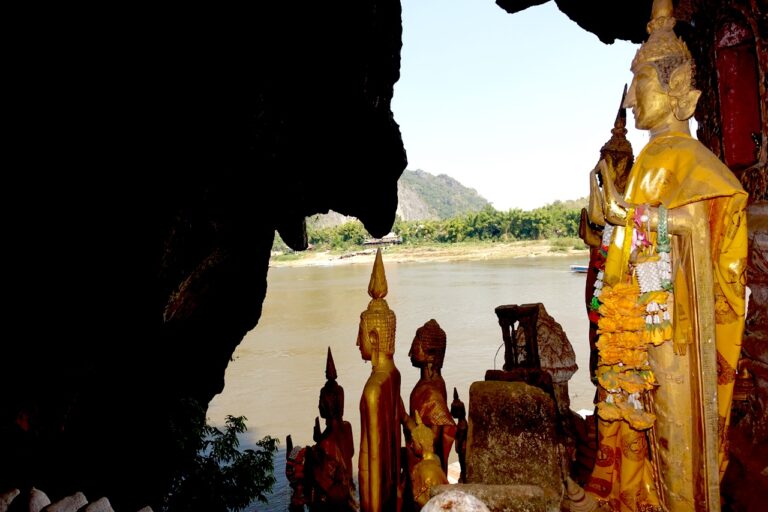
The cave has been an important place of worship for centuries and is closely linked to the spiritual significance of Mount Phousi. Inside you’ll find Buddha images, small shrines and a peaceful space where people still come to pray and leave offerings. It’s quite a contrast to the busy viewpoints further up the hill.
I liked the fact that it felt different from the other temples I visited in Luang Prabang. It’s not a grand temple with ornate roofs or impressive mosaics. Instead, it’s a simple cave that has quietly remained a place of worship for generations. Standing inside for a few minutes also gave me a welcome break before climbing the final steps to Wat Chom Si.
If you’re visiting Mount Phousi, don’t rush straight to the summit. Take your time on the way up and stop at places like Wat Tham Phousi. They’re easy to miss, but they help explain why the hill has been regarded as one of the most sacred places in Luang Prabang for hundreds of years.
| Opening Hours | 6:00 AM – 6:00 PM |
| Suggested Visit | 10–15 minutes |
| Entrance Fee | Included with Mount Phousi ticket |
| Address | Mount Phousi, Luang Prabang, Laos |
Wat Pa Houak
I almost missed Wat Pa Houak while exploring Mount Phousi. It’s tucked away on the hillside and doesn’t attract the same attention as Wat Chom Si, but I think it’s well worth stopping if you’re making your way up or down the mountain.
The temple dates back to the 19th century and is best known for its beautiful interior murals. Although many of the original paintings have faded over time, they are still considered some of the finest examples of Buddhist art in Luang Prabang. It’s quite different from many of the city’s other temples, where the architecture is usually the main attraction.
When I stepped inside, it felt surprisingly quiet considering how many people were climbing Mount Phousi that day. While most visitors were heading straight for the viewpoint, I found myself spending a few extra minutes here looking at the paintings and enjoying the break from the crowds. It reminded me that sometimes the places people rush past end up being the most interesting.
If you’re visiting Mount Phousi, don’t just focus on reaching the top. Take your time along the way because there are several interesting places to discover, and Wat Pa Houak is definitely one of them.
| Opening Hours | 8:00 AM – 5:00 PM |
| Suggested Visit | 20–30 minutes |
| Entrance Fee | Free |
| Address | Mount Phousi, Luang Prabang, Laos |
Haw Pha Bang
You don’t have to climb a hill or cross the Mekong to visit Haw Pha Bang. It’s right inside the grounds of the Royal Palace Museum, yet it’s easy to overlook because many visitors head straight for the museum itself.
The pavilion was built to house the Pha Bang, the sacred Buddha image that gave Luang Prabang its name. According to tradition, the statue originated in Sri Lanka before making its way through Cambodia and eventually to Laos, where it became the country’s most important religious symbol. Although the Pha Bang isn’t always displayed inside the pavilion, Haw Pha Bang remains one of the most significant religious sites in the city.
What caught my attention first was the building itself. The golden roof, the intricate carvings and the colourful decorations make it one of the most beautiful structures in Luang Prabang. I remember walking around it several times because every side seemed to have another detail that I hadn’t noticed before.
Even if you’re not planning to spend much time at the Royal Palace Museum, I think Haw Pha Bang is worth seeing. It’s one of those places that combines history, religion and architecture in a single building, and it helps explain why Luang Prabang became such an important centre of Buddhism in Laos.
| Opening Hours | 8:00 AM – 5:00 PM |
| Suggested Visit | 20–30 minutes |
| Entrance Fee | Included with Royal Palace Museum ticket |
| Address | Royal Palace Museum, Sisavangvong Road, Luang Prabang, Laos |
Wat Phan Luang Ratsoudaram
I only discovered Wat Phan Luang Ratsoudaram because I enjoy walking without following a strict itinerary. It’s not one of the temples that appears in every guidebook, but I often find that those are the places I end up enjoying the most.
The temple is still an active place of worship and serves the local community, giving it a very different feel from some of Luang Prabang’s better-known attractions. There were no large tour groups or queues of people taking photos when I visited. It was simply a quiet temple where everyday life carried on as normal.
I don’t remember every detail of my visit, but I do remember thinking how easy it is to overlook places like this when you’re rushing between the city’s main sights. Spending a few minutes here gave me a better sense of what Luang Prabang is really like beyond its most famous landmarks.
If you’re spending more than a day or two in Luang Prabang, I’d encourage you to visit a few of the lesser-known temples as well as the famous ones. Wat Phan Luang Ratsoudaram may not be the first temple people recommend, but I think that’s part of its appeal. Sometimes it’s nice to step away from the busiest places and discover somewhere a little quieter.
| Opening Hours | 8:00 AM – 5:00 PM |
| Suggested Visit | 20–30 minutes |
| Entrance Fee | Free |
| Address | Luang Prabang, Laos |
Suggested Temple Itinerary
One of the things I enjoyed most about Luang Prabang was that I never felt the need to rush. The historic centre is compact, many of the temples are within walking distance of each other, and spending time in each one was far more rewarding than trying to visit as many as possible in a single day. If I were visiting Luang Prabang again, this is how I would organise my time.
Day 1 – The Historic Centre
Start with Haw Pha Bang inside the Royal Palace Museum before walking to Wat Aphay, Wat Phonxay, Wat Sensoukharam and finishing at Wat Xieng Thong, the city’s most important temple. If you still have some energy left, climb Mount Phousi in the late afternoon to visit Wat Tham Phousi, Wat Pa Houak and Wat Chom Si before watching the sunset over Luang Prabang.
Day 2 – Across the Mekong
Cross the Mekong early in the morning and explore the quieter side of Luang Prabang. Visit Wat Long Khoun, Wat Xieng Mene, Wat Chomphet, Wat Pa Had Siew and Wat Tham Sakkarin. This was one of my favourite days in Luang Prabang because very few visitors make the crossing, and the atmosphere feels completely different from the old town.
Day 3 – Beyond the Historic Centre
If you have another day, head to Wat Pa Phon Phao to enjoy the views over Luang Prabang before visiting Wat Phan Luang Ratsoudaram. These temples receive far fewer visitors than those in the historic centre, but I think they’re well worth including if you want to see a different side of the city.
Of course, you don’t need three full days to see the temples of Luang Prabang. If you’re short on time, I’d prioritise Wat Xieng Thong, Mount Phousi, and one trip across the Mekong to Wat Long Khoun and Wat Chomphet. That combination gave me the best overall impression of the city and allowed me to experience both its famous landmarks and its quieter corners.
Frequently Asked Questions About the Temples of Luang Prabang
How many temples are there in Luang Prabang?
There are more than 30 Buddhist temples (wats) in and around Luang Prabang, many of them protected as part of the city’s UNESCO World Heritage Site. While it’s impossible to visit them all during a short stay, you can easily explore many of the most important ones in two or three days.
Which is the most beautiful temple in Luang Prabang?
If I had to choose just one, I’d say Wat Xieng Thong. It’s the most famous temple in the city and for good reason. The architecture is stunning, the mosaics are beautiful and it’s one of the most important religious sites in Laos.
Which temples should I visit if I only have one day?
If you’re short on time, I’d recommend visiting Wat Xieng Thong, Wat Sensoukharam, Haw Pha Bang and climbing Mount Phousi to see Wat Chom Si. That gives you a good mix of history, architecture and some of the best views over Luang Prabang.
Is it worth crossing the Mekong to visit the temples?
Absolutely. Crossing the Mekong was one of my favourite experiences in Luang Prabang. Temples like Wat Long Khoun, Wat Xieng Mene and Wat Chomphet receive far fewer visitors than those in the historic centre, and the whole area feels much quieter.
Are the temples in Luang Prabang free to visit?
Many temples are free to enter, while others ask for a small entrance fee, usually between 20,000 and 30,000 KIP. It’s a good idea to carry some cash with you, as card payments are rarely accepted.
What should I wear when visiting temples in Luang Prabang?
Dress respectfully by covering your shoulders and knees, and remove your shoes before entering temple buildings. It’s also important to speak quietly and avoid disturbing people who are praying or meditating.
What is the best time to visit the temples?
I found the mornings to be the best time to explore. The temperatures are cooler, the light is beautiful for photography and the temples are generally quieter. Late afternoon is also a lovely time to visit, especially if you’re planning to climb Mount Phousi for sunset.
How many days do you need to visit the temples of Luang Prabang?
I’d recommend spending at least two full days if the temples are one of the main reasons for your visit. That gives you enough time to explore the historic centre, climb Mount Phousi and cross the Mekong without feeling rushed. If you have three days, you can also visit some of the lesser-known temples, such as Wat Pa Phon Phao and Wat Phan Luang Ratsoudaram.
Which temple has the best views in Luang Prabang?
For city views, Wat Chom Si on top of Mount Phousi is hard to beat. If you’re looking for a quieter viewpoint, I also really enjoyed Wat Chomphet, on the other side of the Mekong. Looking back towards Luang Prabang from there gives you a completely different perspective of the city.
Can you visit the temples on your own?
Yes, and that’s exactly what I did. Luang Prabang is a very walkable city, and most of the temples in the historic centre are within easy walking distance of one another. Exploring at your own pace gave me the freedom to stop whenever a temple caught my attention and stay as long as I wanted.